St. Wenceslas Concert
Sunday, 1. 10. 2023 at 19:00
Church of the Assumption of the Virgin Mary
Vyškov (Czechia)
Dear listeners,
allow us to invite you, with a brief introductory word, to listen to what we dare say is an unconventional St. Wenceslas concert in the beautiful premises of the parish Church of the Assumption of the Virgin Mary in Vyškov. During the evening, we will offer you a combination of the sound of the human voice, the registers of the church organ, and the colourful tones of the cimbalom. The entire programme is composed exclusively of works by Czech composers, both well-known and perhaps lesser-known composers of the 20th century, supplemented by remarkable compositions by contemporary authors. In a way, it could be said that the concert foreshadows the second half of the 2023/2024 music season, or the approaching jubilee "Year of Czech Music".
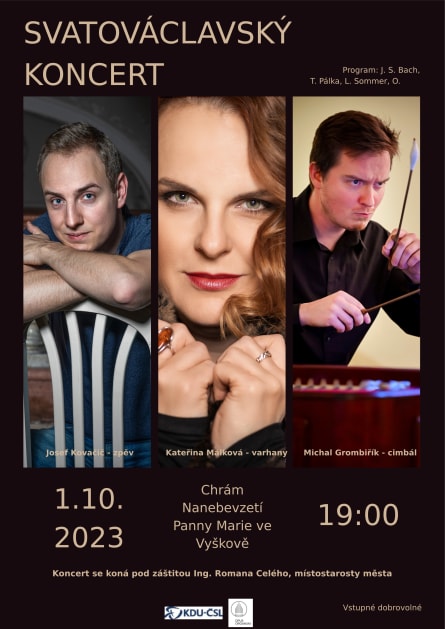
Künstler
- A graduate of the Academy of Performing Arts in Prague under the expert guidance of Martin Bárta and the Prague Conservatory from the class of Jiří Kubík. He made his professional opera debut in 2015 in the role of Hermann (The Tales of Hoffmann) at the prestigious music festival in Bregenz, Austria. In the same season, he was also invited to collaborate with the J. K. Tyl Theatre in Pilsen, where he has since performed many roles as a guest artist, including the Hermit (C. M. von Weber, Der Freischütz), the Ghost of Hamlet’s Father (A. Thomas, Hamlet), Kajetán (Z. Fibich, The Bride of Messina), Charon and Pluto (C. Monteverdi, Orfeo), Seneca (The Coronation of Poppaea), and Kecal (B. Smetana, The Bartered Bride). Since 2016, he has also been a regular guest at the Silesian Theatre in Opava, for example in the roles of the Vagabond (C. Orff, Die Kluge) and Pistola (G. Verdi, Falstaff). In 2018, he appeared at the North Bohemian Theatre in the role of Sarastro (W. A. Mozart, The Magic Flute), and a year later at the South Bohemian Theatre in České Budějovice in the role of Beneš (B. Smetana, Dalibor). Since 2020, he has been a permanent soloist of the opera of the F. X. Šalda Theatre in Liberec, where he is currently appearing in productions of The Cunning Little Vixen (L. Janáček, the Parson and the Badger), Don Giovanni (W. A. Mozart, Masetto), and The Pearl Fishers (G. Bizet, Nourabad). In addition to the theatre, he is also active in concert work and collaborates with renowned musical ensembles such as Collegium 1704, the Moravian Philharmonic Olomouc, Musica Florea, the North Czech Philharmonic Teplice, and the Pardubice Chamber Philharmonic.
- She is the founder of the Opus Organum society, which strives to promote and restore organs, primarily from the Znojmo organ school. This activity is followed by the creation of the Silberbauer’s Musical Thaya Region festival, of which she is the director and programmer. The festival aims to musically connect the Czech and Austrian border regions. Thanks to this activity, the greatest contribution to the field will be the future restoration of valuable instruments by Josef Silberbauer. Kateřina Málková is a promoter of mainly Baroque works, but also of contemporary composers. She always tries to find new places with lesser-known instruments and is committed to their promotion to the general public. She organises a number of concerts in both South Moravia and Lower Austria. In addition to her solo concert work, she is also involved in teaching. She has performed at festivals in Austria, Slovakia, Switzerland, Germany, Latvia, Lithuania and other countries. She collaborates with orchestras such as the Czech National Symphony Orchestra, the North Czech Philharmonic, the Atlantis Orchestra, the Collegium Magistrorum, the Bohuslav Martinů Philharmonic, the Sedunum String Orchestra and others. She studied organ at the Brno Conservatory in the class of Petr Kolař, then continued her master’s studies at the Academy of Performing Arts in Prague with Jaroslav Tůma. During her studies, she completed a one-year internship in Lübeck, Germany, with Arvid Gast.
- A native of Hodonín. In his youth, he was intensively involved in folk music and collaborated with various cimbalom bands and folk ensembles. In 2013, he graduated from the Janáček Conservatory and Grammar School in Ostrava in the class of Daniel Skála. In 2019, he completed his master’s degree at the Janáček Academy of Music and Performing Arts (JAMU) in Brno in music management. He is currently studying jazz interpretation, also at JAMU. In 2009 and 2011, he won top prizes and special jury prizes for the performance of a contemporary composition at the International Cimbalom Competition in Valašské Meziříčí. He has performed in concert with, for example, the Janáček Philharmonic Ostrava, the Symfonica de Castellón (ESP), the Moravian Chamber Orchestra, the Radost Ensemble, the Police Symphony Orchestra, the State Opera Orchestra, Opera Diversa, the Brno Contemporary Orchestra, the Oran Etkin Jazz Band, and others. He is a member of the concert trio ConTRIOlogy and is also involved in his own original projects and various concert and recording collaborations. His musical activities are primarily focused on the fields of contemporary music, free improvisation, and jazz.
- He studied at the Prague Conservatory (viola and composition) and the Academy of Performing Arts (HAMU) (composition), where he studied in the class of Marek Kopelent. He is a founding member of the Chamber Ensemble and the Konvergence society of composers. Since 2010, he has been a teacher at the Jan Deyl Conservatory in Prague.
- He is one of the leading figures of the current generation of young composers. From 1998, he studied guitar with Prof. Vilma Manová and composition with Prof. Jiří Churáček at the Conservatory in České Budějovice. In 2003, he studied for one year at the Prague Conservatory with Professor Věroslav Neumann. In 2009, he graduated from the Academy of Performing Arts, where he studied composition with Professor Ivan Kurz.
- He studied composition at the Brno Conservatory with Pavel Zemek-Novák and at the Academy of Performing Arts (HAMU) in Prague in the class of Marek Kopelent and in the doctoral programme with Milan Slavický. He is a co-founder, member, and chairman of the Konvergence composers’ society. He currently works as a freelance composer and as a therapist in the spa town of Bad Reichenhall.
Entritt
Voluntary admission
Programme
(1929–2007)
’"At night, after hours"’
(1929–2007)
I. O, Light, Holy Trinity
VI. The Passion of Our Lord Jesus Christ
X. I am joyful in this
(1915–2004)
’V. The Wooden Christ
VI. I proclaim grace to him who weeps for it’
(*1975)
premiere
(*1984)
premiere
(*1928)
(*1978)
premiere
(1854–1928)
Good night
(1908–1979)
(1929–2007)
’"In the evening, when the bell tolls for peace"’
Ort
The Baroque, late Gothic parish Church of the Assumption of the Virgin Mary is located on the northern edge of the historic town centre, near the remains of the medieval fortifications. Sources do not mention the origins of the Vyškov parish and church until 1328, when Bishop Jindřich III Berka of Dubá incorporated the local parish church into the Olomouc deanery. During the Hussite Wars, the town was burnt down in 1423 and again during the Hungarian Wars in 1464. During the restoration under Bishop Tas Černohorský of Boskovice, the construction of a new church near the town walls began in 1464. In 1469, however, Vyškov was conquered by his relative, Duke Jindřich Münsterberský, for disobedience to King Jiří of Poděbrady, and the new church was burnt down. There are no precise records from the period 1480-1644. In 1638, Bishop Filip Bedřich Breuner consecrated the main altar of the church. During the Thirty Years’ War, in 1643, the Swedes invaded Vyškov, burning and devastating the parish church. Another blow was the fire of 1753. Between 1760 and 1781, the church was significantly rebuilt in the Baroque style and converted into a single-nave building, vaulted with a semi-circular vault. At the turn of the 18th and 19th centuries, the church received a new organ. The present form of the main altar dates from 1853. At the end of the 19th and beginning of the 20th centuries, a new marble floor was laid in the church, a neo-Baroque portal was added, the interior was repainted, and the organ was completely rebuilt. The church has used electric lighting since 1922. The roof and tower of the parish church were damaged by combat at the end of the Second World War. A long-term restoration project was practically completed at the end of the first decade of the 21st century. The church organ also underwent a general overhaul.
Back to all concerts